

What is happening in Mozambique?
Mozambique is facing one of the world’s fastest growing displacement crises. Conflict, poverty, and climate disasters are driving more and more people from their homes.
Since 2017, armed attacks in the northern province of Cabo Delgado have displaced over one million people. Many people have been displaced than once, as violence spreads across towns and villages. Most displaced families can’t return home and are left sleeping outdoors, exposed to harsh weather and disease.
To make things worse, families already displaced by conflict are being hit again by extreme weather. In late 2024, Cyclone Chido damaged over 150,000 homes. Then came Cyclones Dikeledi and Jude, damaging tens of thousands more.
The need for shelter is overwhelming, but aid efforts are underfunded as global crises grow.
Donate now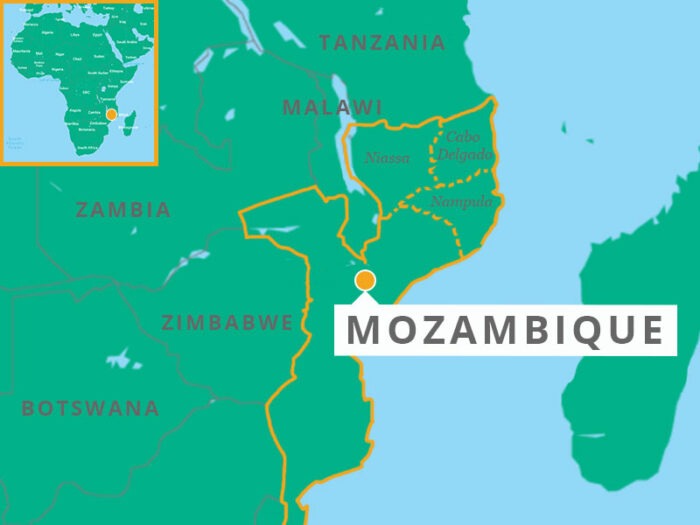
Where is Mozambique?
Mozambique is on the southeastern coast of Africa overlooking the Indian Ocean. It shares borders with Zambia, Malawi, Tanzania, Zimbabwe, South Africa and Eswatini. It has a tropical climate and typically experiences one wet and one dry season a year.
Mozambique has a population of approximately 28 million (INE, 2017). 68% live in rural areas and 60% live along the coastline. Livelihoods in Mozambique depend largely on natural resources.
It is estimated that 46.1% of the of the population is living below the poverty line.
The conflict in Mozambique
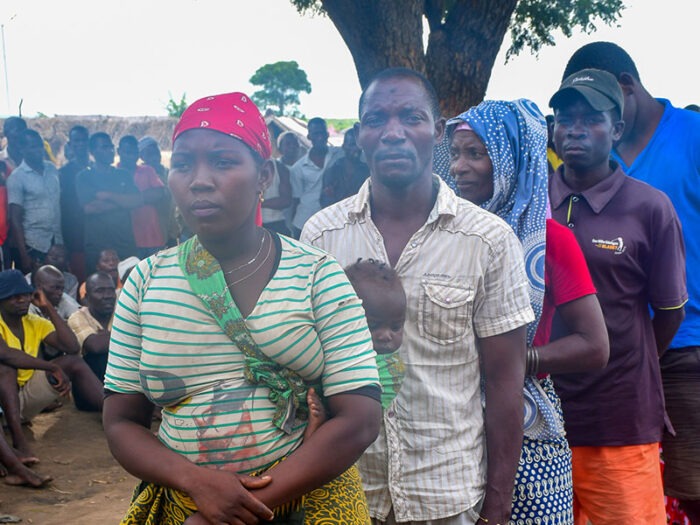
The conflict in northern Mozambique has been causing widespread displacement since 2017. It is one of the fastest growing displacement crises in the world.
In December 2023, rising violence broke out across the Cabo Delgado province, uprooting people from their homes.
People are having to move again and again as areas become unsafe because of the escalating violence. More than one million people have been forced to leave their homes.
The need for shelter is huge, with families sleeping outdoors, exposed to harsh weather, disease and other protection risks.
Why is there a conflict in Mozambique?
Mozambique is one of the most unequal countries in Sub-Saharan Africa. Combined with extremely high levels of poverty, this has created high levels of social tension.
In October 2017 an extremist group, known as Ahlu Sunna Wal-Jama, launched attacks on the northern province of Cabo Delgado.
The group has since carried violent attacks on innocent people, government forces, and military installations.
The violent attacks have been concentrated on the coast of Cabo Delgado, from Pemba city to the Tanzanian border. But, as the violence increases further, it is now beginning to spread into provinces such as Niassa.
In November and December 2024, fresh attacks have caused more areas to become unsafe. As a result thousands more people have had to flee their homes.
Who is affected?
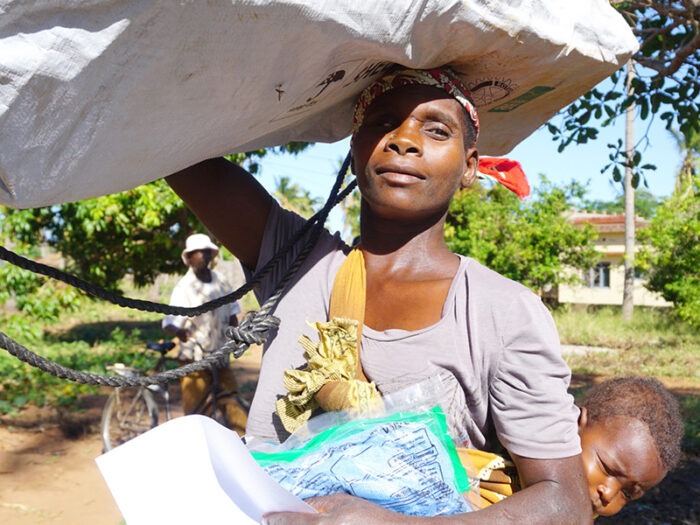
Over one million people have left their homes due to the conflict. Of these, 80% are women and children.
90% of people report shelter as their most urgent need, followed by food. Most people are staying with family and friends in host communities, whose resources are already strained. Now, these same people are having to cope with the destruction of multiple cyclones.
The situation is desperate and chaotic. But as other crises around the world continue to escalate, more and more humanitarian agencies are reporting that they are running out of funds for their work in Cabo Delgado.
Communities bearing the brunt of this conflict need emergency shelter as soon as possible.
what's displacement?How do conflict and climate overlap to drive displacement in Mozambique?
Mozambique is facing a double crisis – conflict and climate change. Together they’re forcing more and more people to leave their homes, sometimes more than once.
In the north, violence in Cabo Delgado has already pushed hundreds of thousands of people to flee. But even after escaping the fighting, many families are displaced again. This time by extreme weather like cyclones, floods, and droughts.
Because of climate change, storms are getting stronger and more destructive. In 2019, two powerful cyclones – Idai and Kenneth – hit Mozambique just six weeks apart. That had never happened before. More recently Cyclones Chido, Dikeledi, and Jude made landfall within three months of each other. They destroyed homes and crops, leaving tens of thousands with nowhere to go.
These storms aren’t happening more often, but they are more intense, so more of them develop into cyclones.
People are losing their homes and belongings again and again, with barely any time to recover before the next crisis happens. Even those already living in temporary shelters are being hit by storms, making it even harder to rebuild their lives.
Farming and fishing communities are especially vulnerable, as their way of life depends on the land and sea. When floods destroy crops or storms damage boats and homes, people are left with no way to earn a living – and no choice but to move.
When they move, they often end up in overcrowded shelters or camps, with limited food, clean water, or healthcare. And the communities hosting them are struggling too, as more people arrive and resources run low.
Mozambique has done little to cause climate change, yet it’s one of the countries suffering the most. About 60% of its people live in low-lying coastal areas – right in the path of rising seas and extreme weather.
Climate and conflict explained

ShelterBox’s response
Since 2021, we’ve supported more than 120,000 people who’ve left their homes due to conflict and a series of powerful cyclones.
Together with our partner CARE Mozambique, we’ve provided emergency shelter and items like thermal blankets, sleeping mats, kitchen sets, mosquito nets, and rechargeable solar lights – and the last of the ShelterBox boxes. Our projects consider the environmental impact of shelter materials, including plastic reuse and recycling.
Tropical Cyclone Chido
Tropical cyclone Chido made landfall in parts of Mozambique on December 15th, 2024. 75% of people affected were women and children, with at least 86,500 houses destroyed or damaged. We supported around 3,400 households – and we plan to support more.
This was one of our first ‘preparedness’ projects in Mozambique, this means we had pre-shipped aid items in June and stored them with our partner CARE, in preparation for the Cyclone season. This meant we could respond quickly and efficiently to the disaster.
We provided essential items like thermal blankets, sleeping mats, kitchen sets, mosquito nets and solar lights, to assist people in their recovery.
Ongoing conflict
With our partner, CARE Mozambique, we have already supported over 70,000 people forced to flee the conflict.
Right now, with funding from the EU, we’re continuing to support families in the north of the country – those hit hardest by the ongoing conflict.
Together with our partner CARE Mozambique, we are providing shelter and emergency household items, like solar lamps, kitchen sets, sleeping mats and mosquito nets to around 6,850 households. We’ve also been looking at the environmental impact of shelter materials, including plastic reuse and recycling.
A continued deterioration in the security situation, means the CARE team is still waiting to complete construction of 500 more transitional shelters as part of our consortium project to support people displaced by conflict.
Support our work
How are we adapting our response to address climate?
Mozambique is vulnerable to extreme weather, and climate change is making storms more severe. We have been listening closely to local communities to understand what kind of support they need most. By storing aid with our partner in the country, we can respond more quickly to the next disaster. It means we don’t have to wait weeks for shipments or find the right materials in local markets.
In July 2024, we moved aid ahead of the annual cyclone season. It meant when Cyclone Chido struck in December 2024, we were able to distribute tarpaulins, blankets, mosquito nets, kitchen sets, and solar lights to thousands of affected people within days.
Looking ahead, we’re exploring using hurricane strapping – a simple, low-cost way to make shelters stronger and more resistant to high winds and heavy rain.
How does climate change affect disasters?