

Tornadoes or twisters are extremely violent storms. When they form, they can wipe out whole neighbourhoods, destroying homes and even killing people.
But what are they exactly and how do they form? Read more to find out everything you need to know about them, including how to support people affected by environmental disasters.
stay informed on disasters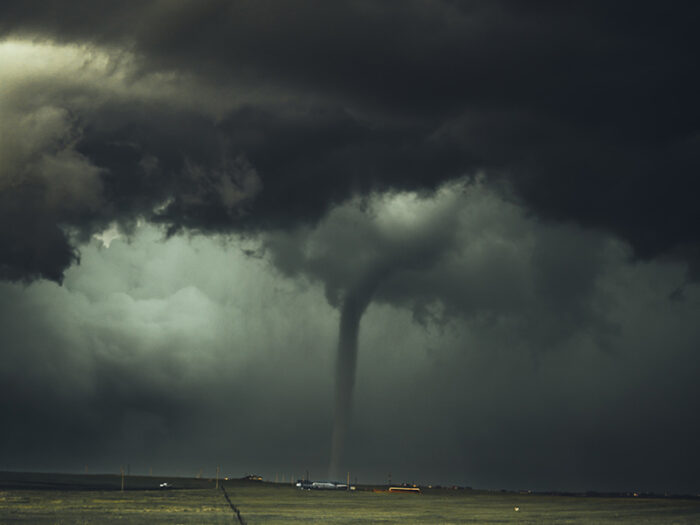

What is a tornado or twister?
A tornado or twister is a narrow, violently rotating column of air. It is usually attached to the base of a thunderstorm, extending to the ground.
But it’s often hard to see it, because wind is invisible. Oftentimes it forms a condensation funnel that has gathered dust and debris. Tornadoes are amongst nature’s most violent storms, with winds sometimes reaching 300 mph.

What causes tornadoes or twisters?
Supercells cause the most violent twisters. These are large thunderstorms that have winds in rotation. In fact, about one in five or six supercells forms a tornado.
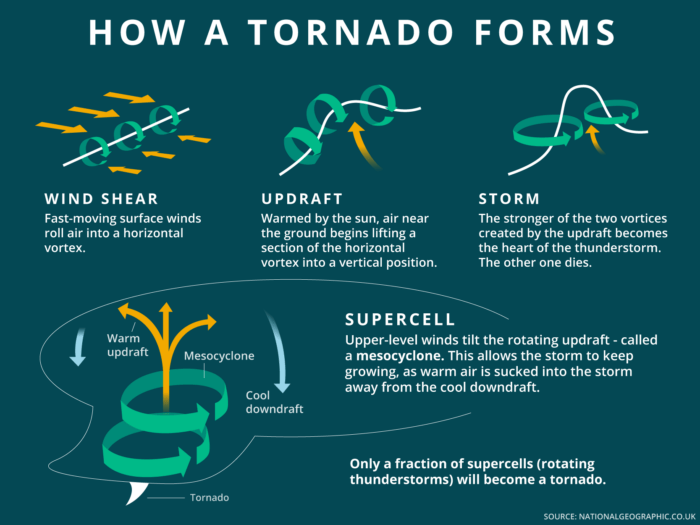
A tornado, or twister, forms within a powerful thunderstorm. As warm air rises and cool air descends – along with rain or hail – turbulent spinning air currents develop inside the storm. Initially, these currents rotate horizontally, but under the right conditions, they shift to a vertical position and extend downward from the cloud, giving rise to a tornado.
How does a tornado form?
Twisters form when warm, humid air meets with cold and dry air. But let’s have a look at it in more detail.
The denser cold air pushes over the warm air, usually producing thunderstorms. In turn, the warm air rises through the colder air, causing an updraft.
As a result, the updraft will begin to rotate if winds vary sharply in speed or direction.
The rotating updraft is called a mesocycle. As it draws in more warm air from the moving thunderstorm, its rotation speed increases. Cool air fed by the jet stream, a strong band of wind in the atmosphere, provides even more energy.
Water droplets from the mesocyclone’s moist air form a funnel cloud. The funnel continues to grow and eventually it descends from the cloud. When it touches the ground, it becomes a tornado. Usually, tornadoes are on the ground for no more than 15 minutes.
Types of tornadoes
Tornadoes form from two types of thunderstorms – supercells and non-supercells. Those that spawn off supercell thunderstorms are the most common but also the most dangerous.
Non-supercell thunderstorms
Types of non-supercell tornadoes include quasi-linear collective systems (QLCS), landspouts and waterspouts.
1 in 5 tornadoes are associated with the quasi-linear convective systems (QLCS). These often form during the late night and early morning hours. But these tend to be weaker than those that form from supercell thunderstorms.
A landspout tornado
A landspout is a tornado with a narrow, rope-like condensation funnel. It forms while the thunderstorm cloud is still growing and there is no rotating updraft.
A waterspout tornado
Waterspouts are like landspouts, but they form over water.
Can you predict tornadoes or twisters?
Scientists know how they form, but it’s very difficult to predict where they will form.
Meteorologists at the U.S. National Weather Service use Doppler radar, satellites, weather balloons, and computer modelling to watch the skies for severe storms and tornadic activity.
The National Weather Service issues a tornado watch when weather conditions develop that are favourable for these violent storms.
Authorities issue tornado warnings when someone has spotted a tornado or weather radar indicates it. People in the warning area should seek appropriate shelter immediately.
How to monitor storms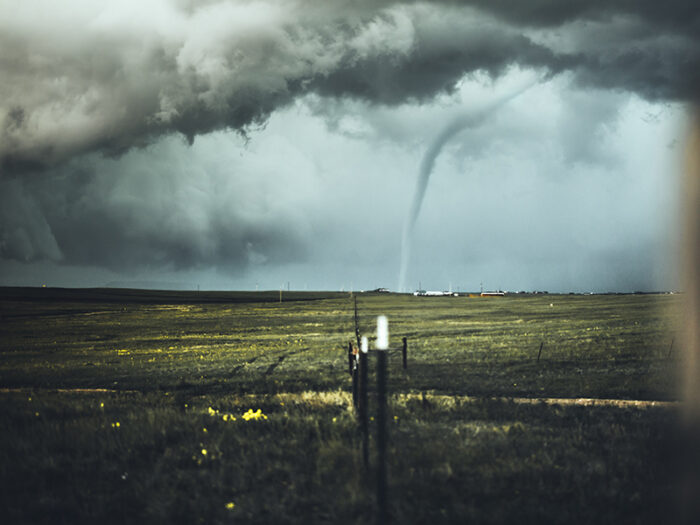
Where do tornadoes occur?
Tornadoes can form anywhere in the world.
Yet, the United States is a major hotspot, experiencing about 1,000 twisters each year. 75% of all tornadoes occur in the US.
Tornado Alley is a region that includes the area in the eastern state of South Dakota, Nebraska, Kansas, Oklahoma, northern Texas, and eastern Colorado.
It sees the most powerful and destructive of these storms. In the United States, they kill about 70 people and injure more than 1,500 each year.
Where are people affected by disasters?
Is a tornado a natural disaster?
A tornado, like other extreme weather events, is not inherently a ‘natural disaster.’
While the term is widely used, it oversimplifies the reality of disasters. Labelling an event as ‘natural’ overlooks the significant role human choices play in shaping its impact. It suggests that the disaster is unavoidable, when in fact, preparedness and response determine the outcome.
- Disasters are created by decisions – factors such as poverty, infrastructure, government readiness, and rebuilding efficiency dictate whether a hazard leads to widespread devastation.
- Hazards are inevitable, but their consequences are not. The choices societies make influence how damaging an event becomes.
- Learn more about the importance of avoiding the phrase ‘natural disaster.’
FAQs: Tornadoes and twisters explained
Hurricanes and tornadoes are both powerful storm systems, but they differ significantly in size, formation, and duration.
While hurricanes move at around 20 miles per hour, tornadoes can reach staggering wind speeds of up to 300 miles per hour, though they affect a much smaller area.
A hurricane is vastly larger than a tornado – typically about a thousand times the size. These storms form under different atmospheric conditions and have distinct environmental effects. Although both generate strong winds and cause severe destruction, they vary in longevity, location, and timing.
Tornadoes tend to be much more compact and often last just a few minutes, whereas hurricanes can persist for days and impact vast regions.
Tornadoes are classified using the Enhanced Fujita Scale, which ranks their intensity across six levels based on wind speeds and potential damage.
- EF-0 tornadoes generate winds between 65–85 mph, causing minor damage.
- EF-1 tornadoes have winds ranging from 86–110 mph, strong enough to cause roof damage.
- EF-2 tornadoes bring winds of 111–135 mph, capable of uprooting trees and tearing apart structures.
- EF-3 tornadoes reach speeds of 136–165 mph, with enough force to severely damage homes.
- EF-4 tornadoes push winds between 166–200 mph, powerful enough to destroy houses entirely.
- EF-5 tornadoes exceed 200 mph, causing catastrophic destruction to bridges and large buildings.
Learn more about storm monitoring.
Yes, hurricanes can happen at the same time as tornadoes or twisters.
Large hurricanes can sometimes also cause a tornado.
A powerful thunderstorm can cause multiple tornadoes simultaneously.
While each tornado has a restricted range, the occurrence of several within the same storm system can lead to widespread devastation, posing a significant threat to communities in the affected area.
Learn about how to support people affected by environmental disasters like tornadoes.