

Earthquakes, also known as seismic events, occur across the world every day. Most of them are too small to cause any damage.
Yet powerful earthquakes – like the ones that affected Myanmar and Thailand in March 2025, or Türkiye and Syria and Morocco in 2023 – can hit hard. And when they do, they claim thousands of lives. Major earthquakes can also trigger tsunamis and other disasters, making them even more devastating.
Discover everything you need to know about earthquakes here.
Support our emergency earthquake appeal- What is an earthquake?
- How are earthquakes caused?
- What are the impacts of an earthquake?
- Can you predict earthquakes?
- Where do earthquakes occur?
- Is an earthquake a natural disaster?
- Is ShelterBox responding to support people affected by earthquakes?
- How can I help people affected by earthquakes?
- FAQs: Earthquakes explained
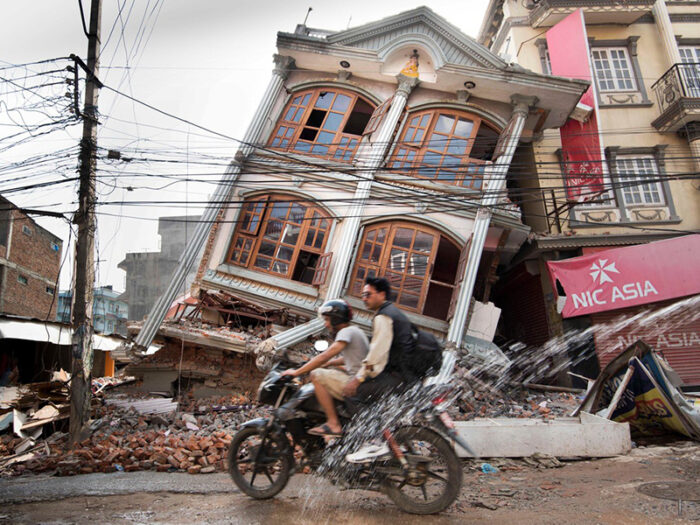

What is an earthquake?
An earthquake is when the ground suddenly shakes. This is because energy is released in the Earth’s outer layer, usually along cracks called fault lines. This energy creates waves that move through the Earth.

How are earthquakes caused?
To understand what causes a seismic event like an earthquake, it’s important to know what tectonic plates are and how they work.
Tectonic plates cover the surface of the earth. They are slow-moving, but they get stuck at their edges due to friction. And when the stress on the edge overcomes the friction, there is an earthquake. This releases energy in waves that travel through the earth’s crust and cause the shaking that we feel.
We call the point underground, where the force builds, the focus. As the strength of the force varies, so do the scale of the quakes. And that’s why some are a lot more damaging than others.
An earthquake can trigger secondary hazards or disasters, that sometimes cause far more harm. This includes an avalanches, tsunamis and flooding.
What are the impacts of an earthquake?
An earthquake can be a scary and traumatic event for a person to experience. Here are some of the impacts that a disaster like this can have.
Aftershocks
Aftershocks are smaller quakes that happen after the largest shock of an earthquake sequence. They can continue over a period of weeks, months, or years. Most powerful mainshocks cause further larger, longer and many more aftershocks.
Liquefaction
Liquefaction is a physical process that can lead to ground failure. It causes clay-free soil deposits, like sands and silts, to temporarily lose their ‘solid’ strength. Thus they behave as thick fluids rather than as solids. The effect is very much like when you wiggle your toes in the sand close to the water.
Tsunamis
A tsunami is a series of giant waves caused by earthquakes or undersea volcanic eruptions.
It sends a surge of water onto land, often reaching heights of over 100 feet. Although tsunami waves do not reach great heights out in the depths of the ocean, as they enter shallower water they begin to grow in energy and height.
Tsunami waves can tear across the sea at speeds of 500 miles an hour. The depth of the ocean determines the speed – travelling as fast as a jet plane over deep waters and slowing down when reaching shallow waters.
Landslides
A landslide is the movement of a mass of rock, debris, or earth down a slope.

Can you predict earthquakes?
The short answer is no, not at the moment. Scientists try to calculate the probability that a major quake will occur within a specific area within a certain time frame, typically a number of years. In the future it might be possible.

Where do earthquakes occur?
Disasters like earthquakes can occur anywhere in the world. But there are 3 regions that see far more intense seismic activity than others:
- The circum-Pacific seismic belt, or the Pacific ‘Ring of Fire’. It sits along the rim of the Pacific Ocean, where about 81% of our planet’s largest quakes occur.
- The Alpide earthquake belt. It extends from Java to Sumatra through the Himalayas, the Mediterranean, and out into the Atlantic.
- The mid-Atlantic Ridge. Most of the mid-Atlantic Ridge is deep underwater. But Iceland, which sits directly over the mid-Atlantic Ridge, has seen quakes as large as at least 6.9 in magnitude.
Is an earthquake a natural disaster?
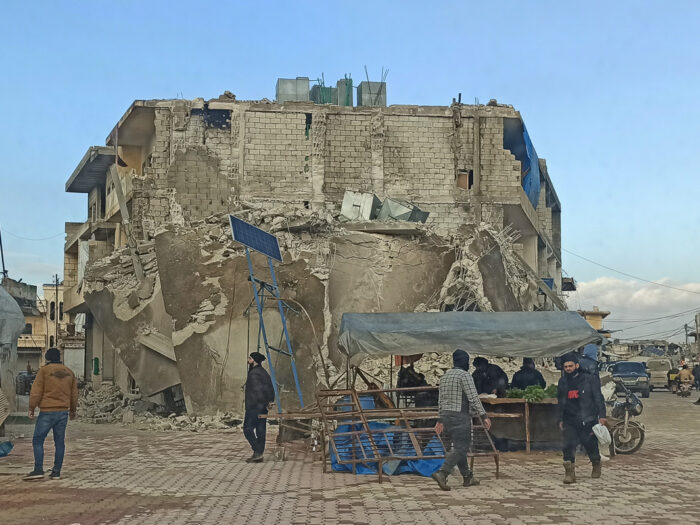
Yes technically. Yet although earthquakes happen naturally, the extent of damage to homes and people often depends on choices made by those in power. In countries that are poorer, less prepared, or with weaker building regulations, big earthquakes can lead to more deaths and damage to buildings. That’s why we try and avoid the phrase ‘natural disaster’.
Wealthier countries, like Japan, New Zealand, are often better prepared with buildings designed to withstand tremors, practice drills for people to evacuate safely, well-trained first responders for search and rescue, and stocks of emergency aid.
learn about why disasters aren't natural
Is ShelterBox responding to support people affected by earthquakes?
ShelterBox is currently responding to the earthquake that hit Myanmar and Thailand on March 28th, 2025.
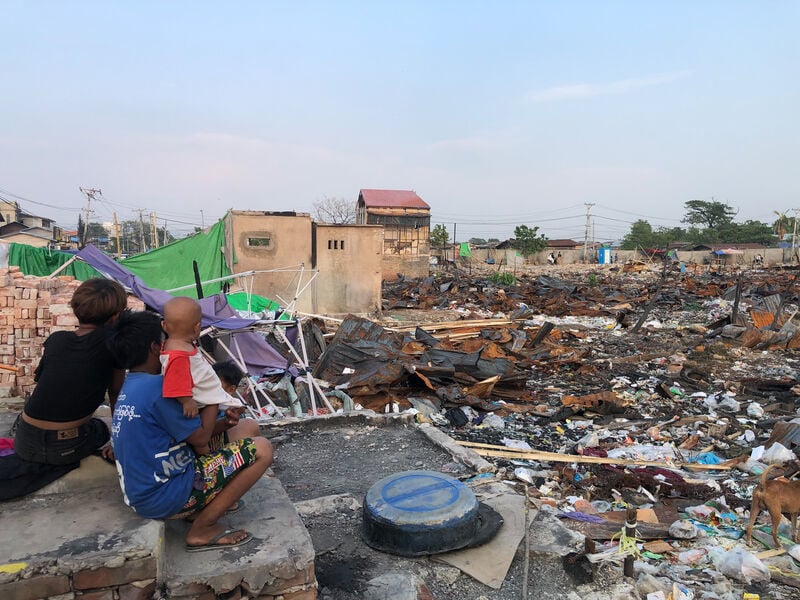
ShelterBox has launched a comprehensive response to support communities affected by the devastating earthquake in Myanmar. We’re reaching 1,000 highly vulnerable households across Mandalay and Southern Shan State – focusing on people who have received little or no support, including those living in the open or in overcrowded displacement sites.
Read about our response
How can I help people affected by earthquakes?
There are several ways you can help people affected by disasters like the earthquake in Myanmar and Thailand.
- Donate to ShelterBox.
- Fundraise to support people recovering from disaster.
- Volunteer with us.
- Raise awareness on social media for response efforts and talk about the disaster with your friends and family.
Donate today
FAQs: Earthquakes explained
Earthquakes happen all over the world where tectonic plates meet, but a lot of them occur in the Ring of Fire.
Many of the countries in the Ring of Fire, including Japan, Chile, the United States and New Zealand have led the way in policy and science – understanding and dealing with earthquakes.
Other countries located in this region include Indonesia, Papa New Guinea, the Philippines, Canada, Guatemala, Russia, Peru, Solomon Islands, Mexico, and Antarctica.
There are many countries across the world that are prone to earthquakes.
Earthquakes are common in China, Indonesia, Iran, Japan, United States of America, Türkiye, India, the Philippines, Italy, and Mexico.
Aftershocks. Aftershocks can often continue for weeks after an initial earthquake. They often last for just a few seconds and range in intensity. They can affect search and rescue efforts and make people fearful to return home.
Communication. Communication networks are often affected. This makes it harder to understand the scale of the damage and co-ordinate a response.
ShelterBox sometimes sends an assessment team to gather as much information as possible, before deciding whether to respond. We have done this for the recent earthquake in Myanmar and Thailand.
Deployed teams use satellite phones and check-in procedures to help overcome communication challenges.
Logistics. Responses must be well-coordinated. This ensures that the right aid is getting to the right people, in the right place, at the right time.
With almost all rapid onset emergencies, coordination with others is essential. Yet this is one of the most significant challenges we face. It can sometimes take time to make contact with key contacts like Rotary, government, other humanitarian organisations, and potential partners. Especially if they have been directly or indirectly affected by the earthquake, or if a shelter cluster has not been activated.
Every country will have its own expectations and processes that must be followed after a disaster. This can slow down response times and draw on staff capacity. Whether they are well established or new processes, these can change at short notice following a disaster due to the fast-moving nature of emergency response.
Services that could be organised with relative ease normally, such as trucks, drivers, warehousing, translators, or accommodation – is likely to be more challenging after an earthquake.
Access / damage to infrastructure. People often most affected by an earthquake will be those near its epicentre and can often be hard to reach. As it’s where most damage is likely to happen, access routes may be impassable or blocked by rubble. Getting aid to people who need it most, can be impacted by long distances and difficult terrain.
Conflict. Pre-existing issues like conflict can make responding to a sudden disaster like an earthquake much more challenging.
Weather. Weather conditions, like extreme heat, cold, strong winds, or heavy rain, can make things more difficult for people who are dealing with a crisis. It can increase the humanitarian need.
Poor weather can cut off certain access routes too or make them more dangerous. Especially in mountainous areas, during ‘rainy seasons’ or in places where there is flooding, ice or snow.
Safety. Likely aftershocks increase the risk associated with deployments. They put response team members on high alert and can increase stress levels. All deployed staff receive training on how to respond to an earthquake or aftershock. But not all staff will have experience working in earthquake zones.
A ‘megathrust’ earthquake forces one of the earth’s tectonic plates to be thrust under another, shifting the earth’s crust.
In 2011 a ‘megathrust’ earthquake with a magnitude of 9 struck off the coast of Japan. This triggered a tsunami with giant waves of up to 10 metres and powerful aftershocks.
ShelterBox supported thousands of people across the affected coastal areas in Japan. We provided emergency shelter aid as well as winter clothing to help people survive the freezing conditions.
In 2004 a ‘megathrust’ earthquake with a magnitude of 9.1 struck Northern Sumatra. This triggered the Indian Ocean Boxing Day tsunami the devastated Indonesia, Thailand, India, and Sri Lanka.
ShelterBox launched the largest response in its history. We supported thousands of families with emergency shelter aid and other essential items.
No. A 10.0 earthquake has never been recorded. It is deemed unlikely to be possible due to the nature of the earth. The largest recorded earthquake was in 1960, in Chile.
Scientists use the Richter scale to measure the strength, or magnitude, of earthquakes.
Charles F. Richter developed the scale in 1935. This measures from 0-9. See below to understand scales of earthquakes and their power.
Earthquakes between 1-4 can occur every day, around the world.
The Richter scale can be a confusing measure as the scale grows very rapidly. For example, a 7.8-magnitude earthquake releases nearly 16 times more energy than one measured at 7.0.
The depth at which an earthquake occurs is a key factor. The shallower the occurrence, the more destructive an earthquake is likely to be. ‘Shallow’ earthquakes tend to be between 0 and 70km deep. It is earthquakes on the shallower end of that spectrum – between 0-30km – that concern us most. The recent 7.7 earthquake that hit Myanmar and Thailand, was just 10km deep.

One of the most powerful earthquakes was the 2010 Haiti 7.0 magnitude quake. See how we helped in Haiti.
The recent 7.7 earthquake that hit Myanmar and Thailand was one of the most powerful earthquakes, in context, a 7 magnitude earthquake could create enough energy to heat New York city for one year. It is so severe, it occurs every 50-100 years and causes major damage.
According to USGS (United States Geological Survey), these are the four largest earthquakes ever recorded:
- Bio-Bio, Chile, 1960. It was a 9.5 magnitude quake.
- Southern Alaska saw a 9.2 magnitude quake in 1962.
- 9.1 magnitude quake off the West coast of Northern Sumatra, in 2004. The deadly Indian Ocean tsunami of 2004 followed shortly after. Working closely with local Rotary partners in Indonesia and Sri Lanka, we provided aid and essential items to thousands of families.
- 9.1 magnitude earthquake Tohoku earthquake, Japan, in 2011. Working with Rotary, we provided emergency shelter aid and winter gloves, scarves and hats to help people survive the freezing conditions.
- Most recently, an earthquake of 8.8 magnitude, one of the strongest earthquakes in modern history, hit Russia’s eastern Kamchatka Peninsula.
ShelterBox has responded to around 40 earthquakes, including those triggering tsunamis. We have supported more than 500,000 people.
Our first earthquake response was India in 2001. Most recently, we’re planning to support people following the earthquake in Myanmar and Thailand.
- Gujarat, India, 2001. The Gujarat earthquake, also known as the Bhuj earthquake, killed nearly 20,000 people. The 7.7 magnitude earthquake destroyed nearly half a million homes in India. Including over one million structures.
It was our first-ever response. We worked in partnership with local Rotary contacts. We supported families who had been badly hit with emergency shelter aid and other essential items.
- Indian Ocean tsunami, 2004. An earthquake with a magnitude of 9.1 – the fourth largest recorded – struck Northern Sumatra. This triggered the Indian Ocean Boxing Day tsunami. It affected 14 countries and devastated Indonesia, Thailand, India, and Sri Lanka. It killed nearly a quarter of a million people and left nearly 2 million people homeless.
At the time, we launched the largest response in our history. We supported thousands of families with emergency shelter aid and other essential items. Whilst working closely with Rotary partners in Indonesia and Sri Lanka.
- Haiti, 2010. On 12 January 2010, people in Haiti experienced chaos and destruction on an unimaginable scale. An initial 7.0 magnitude earthquake was quickly followed by aftershocks of 5.9 and 5.5 magnitude. Aftershocks continued to batter the area throughout the following weeks.
We supported more than 140,000 people who’d lost their homes and possessions with essential ShelterBox aid. This included tents, to provide families with emergency shelter to start recovering, kitchen sets to help people cook and eat together again, and mosquito nets to protect against insect-borne diseases like malaria.
It remains ShelterBox’s largest earthquake response in our history.
- Tohoku earthquake and tsunami, Japan, 2011. On 11 March 2011, an earthquake off the Pacific coast of Tohoku, measuring 9 magnitude ravaged Japan.
The earthquake triggered a tsunami with giant waves of up to 10 metres. Aftershocks hit the area the next day, at 6.2. Working with local Rotary groups, we worked throughout the affected coastal areas in Japan. We provided emergency shelter aid as well as winter clothing to help people survive the freezing conditions.
- Nepal, 2015. On 25 April 2015 around noon, a powerful 7.8 magnitude earthquake struck – the worst in the country’s history. It was felt as far away as Delhi and whole villages across Nepal were flattened. It was followed by a second tremor 17 days later. 9,000 people lost their lives.
We helped provide shelter for almost 68,000 people left homeless after the Nepal earthquakes.
- Lombok and Sulawesi earthquakes and tsunami, Indonesia, 2018. In August 2018, a powerful 6.9 magnitude earthquake shook the island of Lombok, turning thousands of homes into rubble. This was followed by a series of powerful aftershocks. These caused landslides, power outages and further damaging of homes. At the end of September, another deadly earthquake and a tsunami devastated the island of Sulawesi.
We responded to both disasters, supporting families in Lombok with tents and shelter kits. Whilst providing vital items like water purification kits, tents and mosquito nets in Sulawesi.
- Mindanao, Philippines, 2019. In October 2019, three powerful earthquakes shook Mindanao Island. This turned 21,000 homes to rubble, and severely damaged 7,000 homes. Thousands of people fled to evacuation centres, and some stayed with host families.
Working closely with Rotary and the local government, we supported 7,500 people with emergency shelter aid.
- Haiti, 2021. Haiti was experiencing the turmoil of issues exacerbated by the earthquake in 2010. a 7.2 magnitude earthquake struck on Saturday 14 August 2021, which was felt across the Caribbean. Shortly after the earthquake, Tropical Storm Grace hit. For two days, at least 25cm of rain hammered the southwest of Haiti. This was followed by flash floods and mudslides. More than 135,000 homes were damaged or destroyed and over 2,200 people died.
Working in partnership with Habitat for Humanity, we provided emergency shelter aid and other essential items like thermal blankets, solar lights, mosquito nets, and water carriers. We also provided cash assistance. This allowed families to buy the materials they needed to rebuild their homes.
- Turkey and Syria, 2023. In February, a series of powerful earthquakes struck southern Türkiye, close to the northern Syria border. More than 55,000 people lost their lives and almost six million people were displaced.
In partnership with Rotary in Türkiye, we were able to respond quickly, with an initial response team arriving in Türkiye within days. We supported more than 12,500 people across both countries. Providing emergency tents and essential items like thermal blankets, mattresses, stoves, water carriers, and solar lights.
In Syria, the earthquakes displaced people who had already fled their homes because of conflict. Through our partner, Bahar, we supplied tents, high thermal blankets, mattresses, solar lights, and water carriers.
- Morocco 2023. A devastating earthquake in Morocco left nearly 3,000 people dead, thousands more injured, and damaged some 50,000 homes. Many of those homes were in remote mountain villages – and winter was fast approaching. A powerful 6.8 magnitude earthquake struck Morocco late on Friday 8th September 2023. ShelterBox responded in Morocco, supporting thousands of people left homeless by the earthquake. We worked hard to get tents, thermal blankets, solar lights, and kitchen sets to communities without adequate shelter in mountain villages.
- Myanmar and Thailand, 2025. After the powerful 7.7 earthquake struck Myanmar in March 2025, our teams have been deployed to assess how we can help. Support these lifesaving efforts here.