

What is happening in Yemen?
Yemen is one of the world’s worst humanitarian crises. It is a result of the bitter civil war, starvation, and a failing economy. Over 18 million people are in need of assistance, that’s more than 55% of the population.
Together with our partner BCHR (Benevolence Coalition for Humanitarian Relief), we are supporting vulnerable communities.
Read more about the crisis in Yemen, how it affects people, and get some crucial facts and figures.
Donate nowOverview of the crisis in Yemen
Over 18 million people need humanitarian support

6.7 million people require shelter assistance

80% of displaced people are women and children (UNHCR)
Yemen is facing one of the world’s worst humanitarian crises. Years of conflict, poverty, and climate shocks have forced millions from their homes.
Since 2014, civil war between Yemen’s government and the Houthi movement has devastated the country. Over 18 million people – more than half the population – need support, including 4.5 million people who have been displaced.
Many families have been forced to move again and again, relying on aid just to survive.
A brief truce in 2022 brought hope, but it only lasted six months. Fighting now continues, making it impossible for many to return home.
Yemen remains divided, people are still being displaced, and delivering help is increasingly difficult. On average, displaced families have been without stable homes for eight years – some children have only known war.
The crisis is made worse by extreme poverty, and repeated climate shocks like droughts, storms, heavy rains, and locust swarms. Recent attacks on key trade routes and ongoing airstrikes have deepened the crisis.
Where is Yemen?
Yemen is a country in West Asia, found in the southwestern part of the Arabian Peninsula. The land is mostly made up of mountains and dry areas.
Why is there a war in Yemen?
Since 2004, The Houthi movement has been leading an insurgency against the military in Yemen. The movement is known officially as Ansar Allah. In 2014, tensions between Houthis and government forces escalated into outright civil war.
Protests around the 2011 Arab Spring had pressured Yemen’s President Saleh to hand power to his deputy, Abdrabbuh Mansour Hadi. The transition was not smooth.
As security forces withdrew from outlying provinces, the Houthi rebels took advantage and captured territory in the north. They also had growing support from Yemenis tired of Saleh’s decades-long regime.
By the end of 2014, Houthi forces had occupied Yemen’s capital city, Sanaa. In early 2015, President Hadi fled Yemen.
After Hadi appealed to the international community, Saudi Arabia led a coalition of Arab states to try and restore full power to the Yemen Government. Relentless airstrikes and ground offensives killed thousands of civilians.
Has there been a ceasefire in Yemen?
Yemen has experienced periods of ceasefire, but their success has been mixed.
Since the offensives of 2015-16, there has been a political stalemate. This has been punctuated by failed ceasefires and collapsing alliances.
As a result, the UN released a bleak report in 2018 calling this ‘the worst humanitarian crisis in the world’. It said that war crimes had been committed on all sides.
In the same year, the UN negotiated the Stockholm Agreement between the Yemen Government and Houthis. It was a desperate bid to protect the vital port of Hudaydah from further fighting.
Two-thirds of Yemen’s people depend on this port for food, medicine, and aid. Its destruction would have been catastrophic. The agreement has not fully achieved its goals, and its effectiveness continues to be debated.
In April 2022 another ceasefire was agreed. During this time there was an improvement in humanitarian conditions and a reduction in the intensity of conflict. But this ceasefire came to an end in October. Although violence has not re-escalated to levels seen before the ceasefire, families are still at risk. Efforts to establish a lasting ceasefire continue, but the situation remains fragile.
The conflict has displaced 4.5 million people since 2015. Of these, one third are estimated to live in informal settlements. Here they are exposed to many risks including extreme weather and landmines. Many families are crowded into single shelters.
The Houthis’ Red Sea attacks
From November 2023, the Houthis – who control northern Yemen and the Red Sea coast attacked ships in the Red Sea.
This sea is very important for global trade. Because of these attacks, many cargo ships and tankers now have to travel around the southern tip of Africa to avoid danger.
The Houthis had agreed to stop targeting commercial shipping in the Red Sea. However, after a period of fewer attacks, fighting has started again near Yemen’s coast. Several ships have been attacked, and this has led to airstrikes in return.
People are now more worried about how safe it is for ships to travel in the area. The Houthis also stated they’ll keep targeting Israeli ships, as long as Israel continues its offensive in Gaza. This is to show their support for the Palestinians amid the conflict.
The ShelterBox project in Marib is in an area controlled by Yemen’s internationally recognised government. Shipments of aid, project timings and access are being affected, but we have been able to continue to provide support. We are closely monitoring the situation in case it gets worse.
Why is the Red Sea so important for global sea trade?
The Red Sea and the Suez Canal are a vital waterway for commercial and humanitarian international trade. It’s the shortest and most efficient route between Europe and Asia. Around 22% of the global sea trade passed through the canal in 2023, carrying goods such
as natural gas, oil, cars, and manufactured goods. Humanitarian organisations also use this route to ship critical aid around the world.


Who is affected by the Yemen crisis?
The crisis in Yemen goes far beyond the conflict itself. Intense deprivation and lack of services create new and spiralling crises every year.
18.2 million people – that’s half of the entire population – need humanitarian support.
Of these, 4.5 million people have been internally displaced. 83% of these people have identified shelter support as their priority need.
Most displaced people have been away from home for more than 2 years. Many people have been displaced two times or more. The average time of displacement is eight years. Some of these people are moving again and again. They are exhausted and extremely vulnerable.
Donate now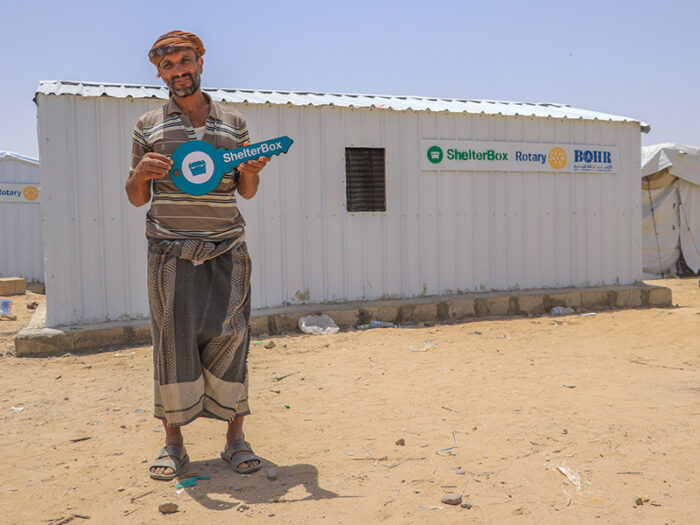
How is ShelterBox supporting people in Yemen?
Since 2021, we’ve been working with the BCHR (Benevolence Coalition for Humanitarian Relief) supporting people forced to flee their homes.
We began by supporting thousands in Marib with tents, shelter materials and essential items like water filters, blankets, sleeping mats, solar lights, mosquito nets, water containers, washing facilities, and kitchen sets.
Marib, in central Yemen, remains one of the greatest areas of need. As displacement continues, recovery becomes harder. That’s why we’re now providing people with more durable shelters with iron frames, concrete bases, thermal insulation, and corrugated steel exteriors. Families also receive mattresses (with thicker options for people with disabilities), blankets, kitchen sets and fire extinguishers. Learn more about iron net shelters here.
We’re also involving communities more by setting up local committees to maintain shelters and ensure support is accessible and shaped by the people who need it most.
Read about our responseHow are we adapting our response to address climate?
The iron framed shelters we’ve provided since 2023 are designed to withstand Marib’s harsh climate, have better ventilation, and typically last longer than standard tents.
In our latest project, we’ve made the shelters even better. They’re larger, allowing families more space, with internal walls for privacy, thicker insulation, as well as air coolers and improved window placement for better ventilation.
These stronger shelters provide better protection from flash floods and sandstorms, which are frequent in the areas where displaced people settle.
To support people affected by floods, we have continued to make items like tarpaulins and rope available so that people can make repairs when needed.
how does Climate and conflict link?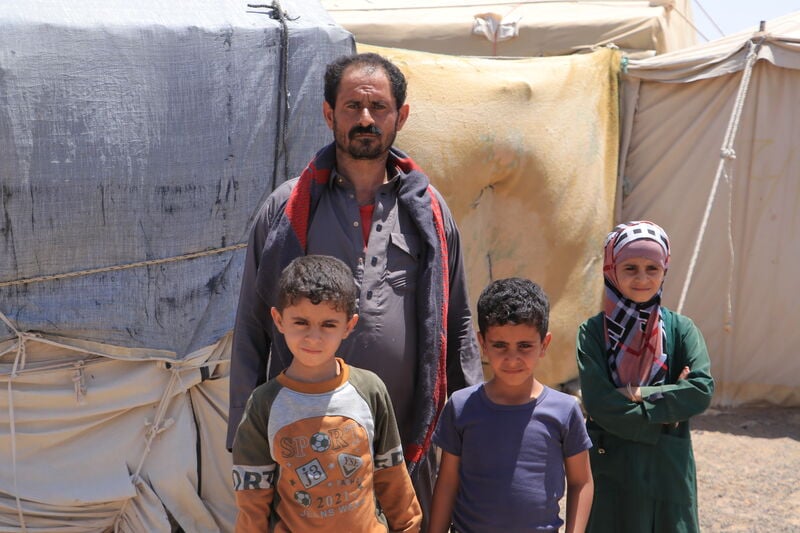
Ali’s story: facing climate and conflict
Displaced by conflict and exposed to the harsh realities of climate change, Ali and his family were forced to flee their home and seek shelter in a remote desert camp. With temperatures soaring and resources scarce, ShelterBox provided essential aid to help them survive and rebuild.
Read Ali's storyWe were living in a tent made of cloth and sticks. It was unbearably hot, and we had nothing.
– Ali
How can I support people affected by the crisis in Yemen?
The best way to support people in Yemen is to donate. This will enable us to reach more people with shelter and essential household items to enable them to survive.
You can also read more about the crisis below, sign up to our mailing list to stay up to date, and share on social media to help us raise the profile of what’s happening in Yemen and the hardships people face.
Donate todayWhat life is like in Yemen
Yemen has been on the brink of famine for years.
Food, water, and finances were already unstable before the civil war. Now, 13 million people are at risk of starvation.
The Saudi blockade of Yemen was designed to put pressure on the Houthis by blocking ports, airspace, and land borders. It has limited food supplies and driven up prices. There have also been claims that Houthi forces have stopped food aid from reaching civilians. And, as the Ukraine war limits grain supplies and drives up costs, more people are facing famine-like conditions.
In the summer season, temperatures can soar above 40 degrees Celsius. Without a food or water supply, this makes finding a secure source of food and water difficult. In the monsoon season, flash flooding devastates communities, destroys homes and crops and worsens the living conditions for displaced people.
Homes don’t mean safety in Yemen. A large proportion of deaths from airstrikes happened in residential areas.
Yemen’s 4.5 million displaced people are living in a range of settings. That includes tents in displacement camps to unfinished buildings and the shells of former homes – or spending their last precious savings on sky-high rents.
Many families don’t have basic items like cooking sets, blankets, or mats to sleep on. They had to leave everything behind when they fled.
Shelters are battered from years of use and exposure to the elements, such as recent heavy rainfall and the harsh extremes of a desert climate.
Marib is a governorate in central Yemen. It is at the centre of the conflict in Yemen, and hosts over one million displaced people, seeking refuge from the violence.
This is the largest population of displaced people in Yemen.
Shelter needs are huge. Many people live in overcrowded camps without basic amenities like clean water, sanitation and electricity. Shelters are makeshift, built with old sheets and plastic, making them extra vulnerable to flood and fire damage. Women and children are especially vulnerable due to lack of privacy and safety.
For most of the war, Marib has been spared the worst of the conflict and became a sanctuary for many. As a result of intensifying conflict in 2021 due to the ongoing Houthi offensive, the rates of new displacement in and around Marib increased. High numbers of make-shift displacement camps emerged. The majority lack proper planning and are acutely underserved. Families face the constant threat of further displacement. They are very vulnerable to damage in the harsh weather conditions in the region.
In March 2023 there was an increase in armed clashes and shelling in the Marib regions.
The security situation is extreme. Marib is facing increased attacks and violence. This further complicates the delivery of humanitarian aid and protection of vulnerable people.